Location Rebel Academy/How to Become an SEO Freelancer

  • Free

How to Become an SEO Freelancer

  • Closed

We cover the four tenets of SEO: Keyword research, On-Site Optimization, Competitive Analysis, and Link Building. This gives you a full understanding of the most essential SEO components.

Contents

How to Become an SEO Freelancer

So you want to learn all of my secrets for how I’ve built MY successful lifestyle business? Well, my friend, you’ve come to the right place.

In October 2009 I quit my job as a portfolio analyst for an investment firm and had no clue what was next.  I wanted to travel, I wanted to have an adventure, and I wanted to find a way to not have to live on the streets to do it.

When I began doing search engine optimization, I knew nothing about it, and, aside from being pretty good with a computer, I really didn’t know that much about the internet (at least compared to where I’m at now). If I could build a successful business doing this, anyone can.

As a note, even if you choose not to make this your primary business, having some basic SEO knowledge will be very beneficial to whatever business you choose in the future.

The Current State of SEO

    SEO Blueprint Section 1: Lifestyle

    What is Search Engine Optimization?

    When I tell people what I do, I usually get a lot of blank stares. “You do search engine what?”

    Chances are if you’ve made it this far, you have at least an idea of what SEO is. In case you don’t, in the simplest terms, the purpose of SEO is to get your (or your client’s) websites to rank higher in the search engines (primarily Google).

    Seems simple, right?

    Well, the ideas behind it are pretty simple, but everyone has a different idea of exactly what goes into SEO and only a few higher-ups at Google know the real algorithm.

    Throughout this course, you’ll learn the widely accepted basics as well as a few secrets I’ve learned to make thousands of dollars from SEO.

    What Does Your Life Currently Look Like?

      SEO Blueprint Section 2: SEO Basics & Competitive Analysis

      Before we really jump into this, we need to cover a few bits of housekeeping with this particular blueprint.

      For one, it’s a little bit longer than some of the others. Mostly because I have more experience with it than some of the other skills. Along with that, as I’ve mentioned it’s really good stuff to know regardless of your niche, so I don’t want to leave any stone unturned.

      Much of the basic skill building is going to based on one of the most popular posts I’ve ever written: “How to Become an SEO Freelancer in 48 Hours.”

      That said, in order to really make this worth your while, I’m going to throw in some of my special secrets.  Things such as how I and others have been able to rank for really competitive key terms and how you can kill it with local search and find a limitless supply of clients in the process.

      So now that we’ve got that out of the way, you ready for this?!

      Time to become an SEO freelancer…

      The Basics of Search Engine Optimization
        SEO Basics_ List of Resources.pdf
        • 37.8 KB

        SEO Blueprint Section 3: Keyword Research & On-Site Optimization

        Keyword research is arguably the most important part of a good SEO campaign.

        The bottom line is that if you select keywords with too little traffic, you’ll have wasted a lot of time optimizing and see little in the way of results. On the other hand, if you choose keywords that are too competitive, you’ll spend way too much time trying to achieve high rankings, and you may or may not ever get there.

        So how do you come high-quality quality keywords?

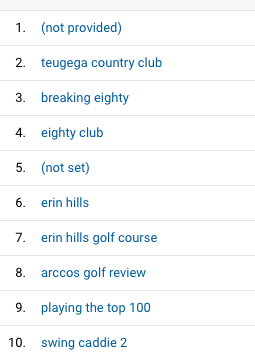
        I mentioned this in the last section, but the very first thing I do when I’m analyzing a site is to check the Google Analytics for “seed keywords.”

        Here’s an example from Breaking Eighty:

        By looking at the keywords that people are already using to find the site, you’ll have a great idea of where to start. There are literally millions if not, billions of keywords out there.

        The majority of keywords are going to be in that (not provided) box but you can still find some good keywords from the remaining numbers.

        Here are some of the best tools for coming up with your initial keyword list:

        • Google Keyword Planner: This is the de facto free keyword tool out there. When I need a free solution for keyword research, this is the first place I go and where I recommend you go as well. You can access it through your own Google Adwords account. Brian Dean from Backlinko has an awesome guide on using the Keyword Planner.
        • Bing Keyword Research: This is Microsoft’s Keyword Research website. It can be useful, but you have to give them quite a bit of information to get going. Best for people doing Bing Ads or who don’t want to pay for premium research tools.
        • Wordtracker Keyword Suggestion Tool: Like a lot of SEO Tools out there, Wordtracker has a lot of premium tools available for a lot of money. However, this is a useful tool nonetheless, and signing up for a free trial will give you access to their basic tools for no cost.
        • Mangools: If you’re going to get serious about SEO, then getting more serious software may be necessary. This is one of the most basic premium SEO tool out there. It’s also one of the more affordable tools and offers a lot of options for a beginner.
        • Long Tail Pro: Similar to Market Samurai, but these days I’d actually probably recommend it over MS – even though I have more personal experience with the former. It gives information that’s just as good for the most part and works a lot faster.


        Premium SEO Tools
          Recovering from a Penalty and the State of Article Marketing
            SEO Blog and Site Optimization Checklist.pdf
            • 38.8 KB

            SEO Blueprint Section 4: Link Building and Guest Posting

            Link building is without a doubt one of the most time consuming, miserable, yet important parts of SEO.

            Part of the reason I have such a disdain for it is that the search landscape is constantly changing, and what was working yesterday not only may not work tomorrow but could actually hurt you.

            When it comes to link building everyone has a different opinion on how it should be done and what works, what doesn’t, and what works but is unethical.

            In this section, I’m going to share a brief history of link building so you understand how things have evolved, and then share the best “white hat” strategy out there for building links.

            I should note right now that if you’re looking for scammy, spamming, black hat tactics – you won’t find them here.  These days I do things the way Google wants me to, and while it may not get me results as quickly as some of the spam tactics, it works over the long term and doesn’t leave me scrambling to game the system again after every algorithm change.

            That said, I do think it’s important to have an understanding of what some of those tactics are and how/why they work.  It’s up to you to decide how far down that rabbit hole to go.

            The absolute best resources for all things SEO out there are Detailed and Backlinko. Both Glenn and Brian put out incredible content. If you are seriously considering a career in SEO you should read both their blogs and consider their courses too. For getting the basics of SEO beyond what we have here, their sites are great places to start for more information.
            First, Some Backstory
              Advanced Guest Posting Strategies
                Getting Started with Guest Posting for SEO

                  SEO Blueprint Section 5: Local Search

                  I decided to add an entire section to this blueprint on local search because chances are this will be the most directly relevant to you.

                  What are the odds that, with little to no experience, you’re going to get some work right out of the gate doing SEO for a Fortune 500 company?

                  Probably slim to none. (Although, as a side note, one of my first clients was one of the largest children’s hospitals in the country. All about who you know.)

                  That said, this going to be a quick and dirty guide to how you can take a small business and get them to rank highly for their local searches (which have the potential to send them way more traffic than broader terms to, anyway).


                  The Myth of David vs. Goliath

                    SEO Blueprint Section 6: Finding Work

                    For me, finding SEO work has been surprisingly easy.

                    As I’ve mentioned, I’m shocked by how many people (and business owners) still don’t really have any idea what SEO is.

                    They know why they need it and how important it is to rank in the search engines, but many don’t realize there’s actually an entire industry of professionals that do it.

                    What does this mean for you? Opportunity.

                    The Most Important Thing I Did to Find SEO Work